Thursday, December 23, 2010

What's On Your Tree?

I used to have shiny trees that were all decked out with strings and strings of electric lights, shiny balls, spirals,  ribbons, everything!  But after I found Waldorf/Steiner Education and Anthroposohy, all this faded away. Today my tree is much simpler and everything on it means something.


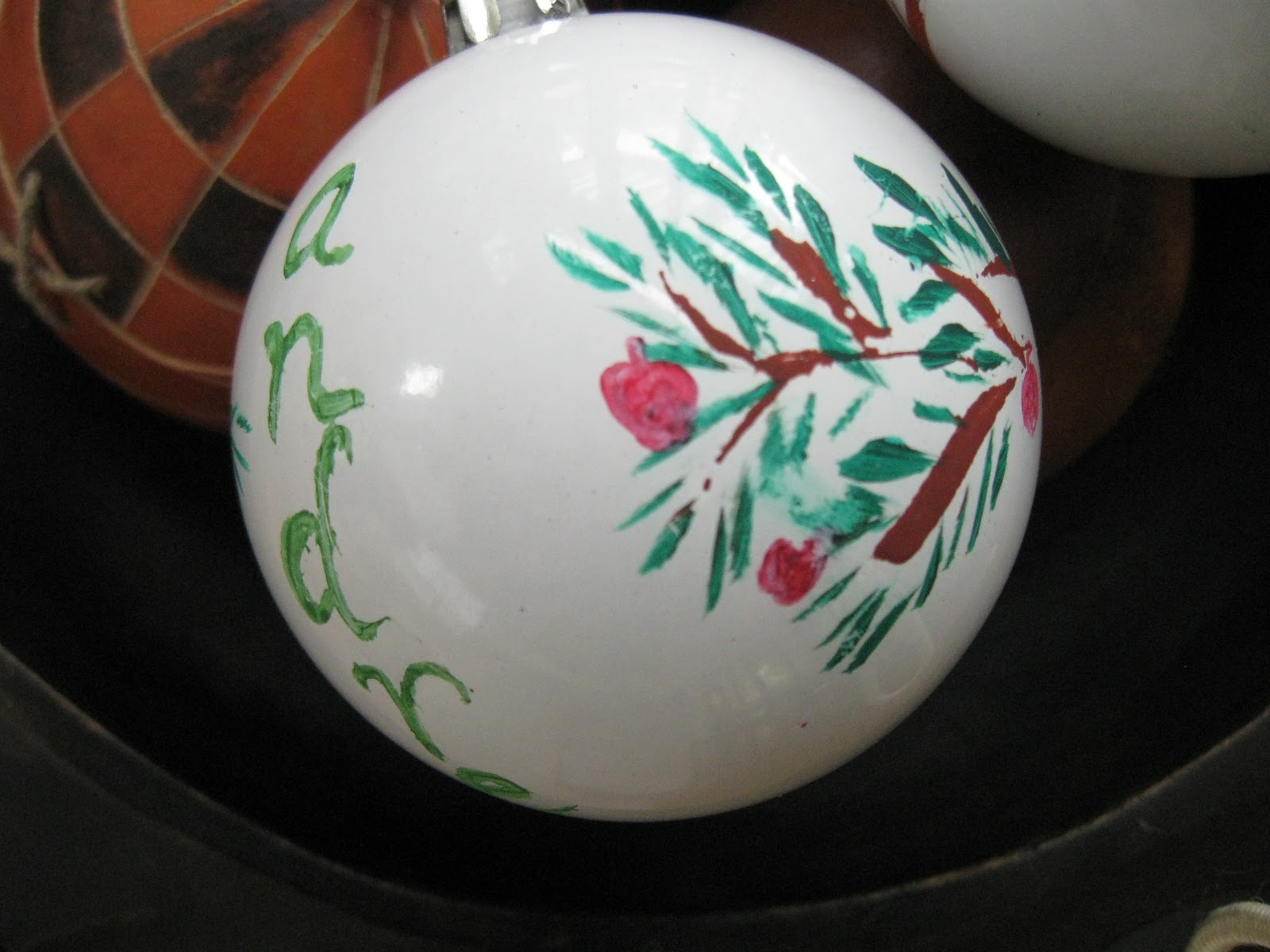
This ball was lovingly hand-painted by a dear friend, Joy, for the boys.

It has their name, the year she gave it and some lovely boughs.

This catches the light beautifully. From my lovely friend,
Denise. 2 little baby balls and 1 mama ball.

Some of them I made.

This my child made.

This little guy was made by Joy as well.

Along with this little fellow.

And this cutie is also by my son.
     These are photo ornaments of my sons, from their first Christmas to the
    present. On the left are handmade ornaments from friends and one ornament
that accompanied an I Can Serve Christmas card many years ago.

These are some of the special ornaments we always have on our tree. Each one has a story behind it and is loved and cherished by us.  On Christmas Eve I will put the final touches of 30 red roses and 3 white, and the 33 candles which will glow for me and my boys on Christmas morning. Our tree is a story of the life we continue to make together. What's yours like?

Friday, December 17, 2010

True Wealth: An Inner Perspective


                                            "Tree of Life" by Gustav Klimt

In my life and work, I have had many encounters with people from all walks of life and I have learned that wealth has nothing to do with how much money you have. Absolutely nothing.

There are those who swim in money but wield it in unscrupulous ways so that it ceases to be economic currency and morphs, instead, into a weapon of mass destruction, chosen especially to perpetuate power struggles.  But there are also individuals who don’t have much, yet manage to create living worlds out of what they have.  Money is just money but the spectrum of our attitudes toward it simply amaze and, too often, horrify. There is the student who will join a group for a meal at a restaurant, make a side trip to the ATM, and then order whatever her budget allows. Then there is the working gentleman who will not order anything, eat off other people and then take their leftovers home.  There are those who would use what they have to hoard objects that define their status in society and indulge in the frequent and public display of it, preferably with lots of press mileage, and others who quietly give what they have towards non-material endeavors.  In all my years, I have finally learned that true wealth is not how much you have but how you stand before it.

If one can stand objectively before material abundance and not become swayed nor controlled by it, gripped by fear and anxiety over the possibility of loss, choked with apprehension, inflated with false power, overtaken by visions of yachts, bling-blahngs, Blahniks, Choos and other trite symbols of money, nor be inexplicably driven to accumulate anything—if one can stand before a truckload of gold and still remain who he is at heart, then I would say that person has in him all he needs in the world. And that is a picture of wealth.

Today our wants have far eclipsed our needs; there is a continent between them.  And there, in the midst of it, is the big white elephant in the living room--money--that is so deeply and unconsciously connected with our emotional life.  Our attitude towards money goes as far back as our childhood and the way our parents dealt with their financial woes and joys, how they gave and received, withheld or shared. Before we come into money, we first inherit our attitude towards it, which determines how we spend and use it for the rest of our lives.  Part of coming into adulthood is to wade through this mess and recreate who we are in relation to money and all it brings, and make conscious patterns and attitudes that have been formed from the outside.

Our challenge in these times is to know when what we have is enough, to discern want from need, and to temper the needs that seem to keep sprouting new needs.  We have to stop the cycle of compulsive consumption, get off that train and behave more responsibly about what we have been given.  We have developed a tendency to use charity as a salve to mask the gaping hole of our diminishing conscience.   We put out here and there, sometimes in big, fabulous, public strokes, to make up for the material indulgences in our own lives.  This gives us a sense of balance and somehow justifies our excesses. But that’s a game.  For as long as we are not creating balance between what we need and what we have in our personal lives, what we have owns us. True wealth shouldn’t leave you shackled.  It shouldn’t separate you from the rest of the real world.  In a perfect world, wealth would simplify lives. Living with what you need and sharing what you don’t is a healthy way to exist and co-exist. 

Money buys you pairs and pairs of shoes, each costing what a family in this country takes months—even years to earn.  It manifests itself around your wrist, drops from your ears, drapes your neck, hangs beautifully from your self-cleaning windows, cushions your bare feet, shuttles you from one pristine island to the next and cradles your now-fragile aristocratic back at the end of your adventures. And there it stops.  It’s about you.

Wealth gives you the sense, strength, will and heart to put this money behind something you want to see happen in your community instead, something you truly believe in, something that doesn’t have to bear your name on it—no plaques, no glory.  You simply look at the bounty, take your share, and then let the rest do its work in the world towards transformative endeavors, hopefully the kind that doesn’t create dependence, but empowers recipients to make the most of gifts they already have, with a little help from you. Wealth is conscious and conscience spending—knowing where your money is going so that you are not supporting initiatives that degrade and hurt the world and humanity. It is putting your money to relevant use. Wealth is money working through you but not just for you.  It is allocation rather than accumulation. It is stewardship, not ownership.

Learning and living this is a process of simplifying and getting to know oneself. It took me years to figure out that too much mold growing on my belongings in storage wasn’t just a mold problem.  It was a problem of having too many unused, stagnant things.  If you’re not using what you have, you have too much! I downgraded, simplified, and find that there is still more room to pare down.  Today, it is a constant practice. Nice shirt, yes, but still white and how many of those do you really need, no matter how often the self-proclaimed style mavens scream, “you can never have enough white shirts!!” You can. You can have too many. You can have too much of anything.  Accumulation is not wealth; it is the opposite. It is making stagnant something that should flow outwardly towards more relevant use.

When I moved to a house a third the size of my former one and began to unpack, I was literally overwhelmed with stuff. Stuffed with stuff. I unearthed Christmas presents from the past that were stored and never used. My burden—and that is truly what it was—was to unload this sorry accumulation.  I sold, gave to friends, donated to charity bazaars and simply put things where they ought to be—not all with me doing nothing, but everywhere else doing something!  Money is a practical way to move in the world and it is our task to make sure it moves through us in meaningful and positive ways.

This perspective would not be complete without a word on stolen or ill-gotten money. It is not wealth and it is not yours. No amount of putting it into “projects for the poor” will make it so.  Raising children on money that is coated in slime is unforgivable.  It is not the way to give them a better life; it is a straight path to a lifetime of murky and unresolved money issues.  What parent would bequeath such a burden to their children?

Wealth carries a strong moral imperative that is passed down to our children (and theirs) by the way we spend--what and when we buy things for them and our current attitudes and habits surrounding money.  What is the right age for them to get their first cell phone, what will it be used for, how will the bills be regulated, what happens when it is lost, what model are you getting for them, how often will you upgrade?  How many pairs of basketball shoes do they have? Need? Laptop vs. desktop? We are monitoring more than the objects themselves but their relevance, use, the short and long term impact on our children’s spending and using habits, their attitudes towards moderation and excess, and ultimately their sense of earning versus entitlement. How do you answer these questions in your own life? 

Yes, you can afford to buy your children anything they want, but should you? Are we living today in a way that passes on a sense of stewardship or ownership of money? We can say all the right things, but in the end it is how we live, share, receive and give that will complete the picture for them and dictate how they will use what they have as grown, productive, responsible, socially-engaged, compassionate members of society.

Very recently my son said to me, “Mama, I heard there’s a billionaire who lives on his own island.  He’s so far away from his office so he has to take his plane to work everyday!” He was so impressed with this picture.  I felt the need to offer an alternative one. “Well,” I began, thankful for the true story I was about to share, “there’s also a billionaire who has given away his money, lives in the same house he’s had since before he was that rich, drives a simple car and travels economy on commercial flights.”  My son looked at me and said, “Why?”  I looked right back at him and said, “Because he chooses to use his money for other things. He’d rather use it to help people.  He has what he needs, so the rest he puts back into the world for good.”  My son was very quiet.  Then he flashed me the biggest smile, full of sudden comprehension and light, and said, “Coooooool. So coooooool.”

Oh yeah. True wealth ought to be just that.

------------------------------------------------------------------------------------------
This piece was written last year for Town & Country. Thank you to reader George Martinez for bringing it to light again. 

Tuesday, December 14, 2010

Sober All By Myself


I'm allergic to alcohol, so I don't drink.  Of course I sort of experimented when I was young, but the discomfort that came with drinking turned me off it. Seeing what alcohol did to people convinced me it wasn't worth it.

I see how people get: slurry, obnoxious, hurtful, emotional, loose-tongued, generally controlled by something other than themselves. It is never a pretty picture.

I hit my thirties and grew tired of being sole witness to people making fools and asses of themselves, so  I put my foot down. Enough. I knew when to stay home. If a certain constellation of drinkers were coming together, I exercised my right to stay away and not be part of the descent into the lower self. It's not fun.

Lately, I've been finding myself among drinkers again and though I find that the years have made me more patient and tolerant, the experience still leaves me full of questions.  Consciousness, clarity, a full sense of oneself, these are all hard-earned faculties. I know that for me they are. I will not give them away for a few hours of inebriation.

I've always been the outsider looking in, and all I can see are people who are wanting to leave themselves, looking for solace, escape, as if there were a way to escape oneself. There isn't.

There is something to be said about appreciating good wine and spirits, but not to the point of letting them take over you, of turning you into someone who would say things you would normally keep to yourself, and inflict on others what you would not be able to otherwise.

To be more fully human is to go with courage into yourself to face life's challenges head on, without needing to dull the soul with substances that would take you away -- not closer -- to everything life has to offer. There is one true way to honor your life and that is to live it in full and active participation.

Tuesday, November 16, 2010

For Wyngard

Rowell, Wyngard, Olive, Agot, me and Garlic

I lost a friend today. In truth, he was so much more than that.  He was a mother to me. I was 15 or 16 when I first met him. Even then he looked out for me, often offering guidance no one else seemed capable of at the time. We reconnected in the early 90s for a few intense years where we spent most nights together eating, laughing, telling stories, and becoming the best of friends. He introduced me to Rei and the three of us made an odd but wildly fun triangle. We would part late at night, only to call each other again to talk and laugh about the evening. At the height of this friendship he said, "Dadating din ang araw na magkakahiwalay tayo, tandaan niyo iyan, mag-aaway tayo, tapos magkakabati na naman tayo, sama-sama ulit, tapos mag-iiba na naman. Ganoon talaga ang buhay." And, of course, he was right.

That intensity died down when I married and had children, though we still saw each other sporadically through the years. When it was just the two of us, we never did small talk. Wyngard was always privy to the major stories of my life and too often predicted stuff I could not foresee, or refused to see. He always knew what others couldn't know. He kept my deepest pains close to his heart and he never forgot. Whenever I tried to make light of things, he saw through me. He would never allow me to disguise my feelings.  He would call me on them and I had no choice but to own up. We always laughed together. He was the epitome of tough love and had no patience for pretension or frivolity.

The last time I saw him he was recovering from a grueling heart surgery. Before the operation, I had visited him and wanted to talk him out of it, but we had reached that point of full acceptance in our friendship.  I respected his decision to heal his physical heart through surgery, even though I so wanted him to approach it differently.  The visit was light and very funny and, as usual, there was no end to his visitors. He was so loved. He survived the surgery and was well enough to see me and other friends for dinner.

He was already sitting at our table when I walked in. He stood up and said, "O, as usual tayo na naman ang maaga." Then we hugged, kissed, and got down to business.  He asked me pointed questions about my life and scolded me for being "too nice".  I laughed, but it warmed my heart to be reminded that he always had my back.  I asked about his surgery and he told me how difficult recovery was and how painful, and I told him I could never have endured what he had.  What were the chances of anyone surviving something like that?

The day I heard of the post-surgery stroke, I had woken up thinking of him.  I had told him I would lend him my Mad Men dvds, and since I live so far from the city, I was working out a schedule in my head.  But it wasn't meant to be. He never quite woke up again.  That dinner we had in September was the last time I saw him. I am happy to remember him that way.

He hasn't left my thoughts since and I am full of gratitude today for everything he was to me.  Each time I shed tears, I also hear his admonishment: "Ang drama ha. Hindi bagay sa suot mo." Or something like that. Even in death he makes me laugh.

There are so many, many memories, but they are for me to keep. I write this now as an offering, to put him here on this space, on this day. I love you, Wyngard, and I will miss everything about you. I thank you for watching over me, for seeing through me, and never allowing me to be anything but myself. Next time will be much better. I look forward to it already.

Today, Wyngard Tracy left the earth and was born to the angels. I am honored to have been part of his journey.


Thank you GARLIC GARCIA for the photo.

Saturday, November 6, 2010

Nostalgia


Yes. it's the 45th anniversary of this wonderful film. I remember it well. It is also a very special film in our family because it's the first my children ever saw.

I watched the Oprah episode with the cast and found myself feeling quite sentimental and nostalgic. Seeing all the actors who played the Von Trapp children as adults makes one feel the passage of time. There were behind the scenes photos, too.  The one that struck me the most was of a very young Julie Andrews holding the hand of her toddler daughter. That photo reminded me of how simple life was for actors at the time and also how actors were actors and not the stars and megastars they are today, constantly hounded by cameras--their bags, shoes, relationships, blings, successes, failures, faux pas, always scrutinized and broadcasted.  You could be an actor then and have a life.  How many of us even knew she was a young mother at the time? What did we really know about her?

Today it's all about too much information.  Just a few nights ago, a local actress was interviewed and suddenly, somehow, they were talking about her underwear.  Who wants to know?  I certainly don't. But the sad thing is, so many others do.  The world today pushes information at you. It's almost impossible to keep it out and many just keep wanting more, thinking nothing of propriety.

How much do we really need to know? The challenge is to know that all that information is out there, but  to be able to determine which ones hold water. I am guilty of the same in this day and age of Twitter and Facebook, but that one photograph brought it home for me.

Simplicity, dignity--these do not have to belong to the past.

Monday, October 4, 2010

A Gift

It's a special day for me. I was putting my house in order when I decided to open a favorite book, The Human Life, by George and Gisela O'Neil. The book opened to this page and I thought it so appropriate, given what we are dealing with in the issues surrounding the RH Bill. It was an uplifting present.

RUDOLF STEINER ON THE THEME: THE NEW LANGUAGE

I am born prejudiced and must first achieve in life the freedom from thought and prejudice. And how can I acquire this here on earth? Only through this: that I unfold interest not merely for what I myself think, what I consider to be right, but that I unfold selfless interest, in everything that others think and that approaches me, however much I consider it to be in error.


The more a man insists upon his own headstrong opinions, and is interested only in these, the more does he stray from the Spirit of Humanity--at this moment of World evolution.


The more a man unfolds his social interest in the views of others, even if he considers them to be in error; the more he illuminates his own thoughts through the views of others; the more he juxtaposes his own thoughts (which he perhaps takes for truth) alongside the thoughts of others, which he considers mistaken but still willingly shows interest in them; the more he will experience within the innermost part of his soul the christ Word that today must be interpreted according to the new Christ language....


In this way Christ speaks today to those who wish to hear Him: "What one of the least of your brethren thinks, you have to value thus, that I think within him and that I feel with you, as you compare his thoughts with your own, as you show social interest for what goes on in the soul of the other.  What you find as notion, as life view in one of the least of your brethren, in this you will seek Me." So speaks the Christ into our thought life...


Christ is the God of all men. We will not find Him when, with our thoughts, we stay egoistically within ourselves, but only when we weigh our thoughts in comparison with thoughts of others; when in inner tolerance we expand our interest in everything that is human; when we tell ourselves: Through my birth I am a man of prejudice. Through my rebirth out of the thoughts of all men, in a broad, social thought feeling, I will find within myself the Christ Impulse. When I do not view myself alone as the source of everything that I think; but view myself, in the innermost part of my soul, as a member of mankind, then a path to Christ will be found.


This is the path that today must be designated as the Thought Path to the Christ. Astern self-education is needed to acquire this sense of reckoning with the thoughts of others. It must become an earnest life task, in conversations with others, to correct what we automatically carry as our views within ourselves. Were this not to take place, as a life task among men, mankind would lose the way to Christ. Today, this is the path of thought...


Don't ask for abstract paths to Christ: ask for these concrete ways. Ask how it is with the path of thought: it consists in becoming inwardly tolerant for the views of humanity, in gaining social interest in the thoughts of others.